Best portable power station for hurricane season: a prep guide
Updated Oct 13, 2026
We may earn a commission when you buy through links on this page. As an Amazon Associate I earn from qualifying purchases.
Hurricanes are one of the main reasons people buy portable power stations, and with good reason: outages after a major storm can last days. A power station won’t run your whole house, but it can keep the essentials going safely indoors: food cold, phones charged, internet on, fans running and medical devices powered. The key is sizing it for a multi-day outage and having a way to recharge.
General information, not medical advice. Power stations are not certified medical backup devices. For life-sustaining equipment such as oxygen concentrators, keep a backup plan, ask your equipment supplier, and register with your utility’s medical-priority program.
Plan for days, not hours
After a hurricane, restoring power can take days or longer in hard-hit areas. A battery alone runs out, so plan your energy budget per day and how you’ll refill it:
| Essential | Typical draw | Energy per day |
|---|---|---|
| Full-size fridge (cycling) | ~150 W while running | about 1,000–1,500 Wh |
| Wi-Fi router and modem | ~20 W | about 480 Wh (24 h) |
| Box fan, 8 hours | ~50 W | about 400 Wh |
| Phones, 2 charges each for 2 people | ~15 W | about 60 Wh |
| LED lights, 5 hours | ~30 W | about 150 Wh |
| CPAP, no humidifier | ~40 W | about 320 Wh |
Everything above adds up to roughly 2.5–3 kWh a day, more than most portable stations hold. That’s why the best hurricane setups combine a 2 kWh-class station with solar panels, and why it pays to prioritize. Use the runtime calculator to build your own list.
Recharging after the storm
- Solar is the most reliable option once skies clear. A station that accepts 1,000 W or more of solar input can refill a 2 kWh battery in a few hours of good sun. See our solar charging guide.
- Your car can trickle-charge a station while you drive, but slowly. Never idle a car in a garage.
- A generator can recharge a station in a couple of hours, so it only has to run briefly, outdoors and well away from the house. Read power station vs generator.
Pre-storm checklist
- Charge the station to 100% when a storm is forecast, and top it up again just before landfall.
- Test it: run your fridge from it for an hour to confirm it starts the compressor.
- Pack the AC charger, solar cables, car charger and a heavy-gauge extension cord in one bag.
- Turn the fridge and freezer to their coldest settings a day ahead; cold food buys you time.
- Freeze water bottles to fill empty freezer space; they help keep it cold and give you drinking water.
- Keep the station indoors, off the floor and away from possible flooding.
Food safety without power
USDA guidance says a closed refrigerator keeps food safe for about 4 hours, and a full freezer for about 48 hours (24 hours if half full). You can save battery by running the fridge in blocks rather than nonstop. Our fridge runtime guide shows how long each station lasts.
Safety
Power stations are safe to run indoors because they produce no fumes. Generators are not: never run one inside a home, garage or partly enclosed space. Never plug a power station or generator into a wall outlet to feed the house; to power hardwired circuits, have an electrician install a transfer switch or power inlet.
Our hurricane picks
These current stations combine enough capacity for a day of essentials with strong solar input or expansion for multi-day outages.
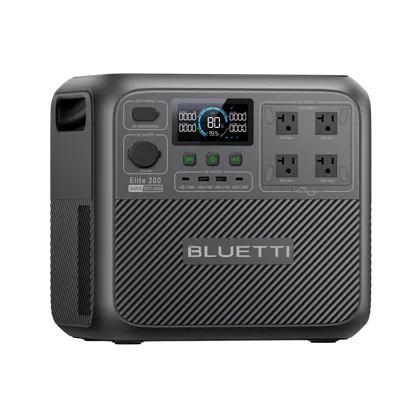
BLUETTI · Large
Elite 200 V2
- 2,074Wh
- 2,600W out
- 53.4lb
2,600 W output, 6,000-cycle LiFePO4 cells and fast 1,800 W wall charging. Not expandable, and heavy at 53 lb.
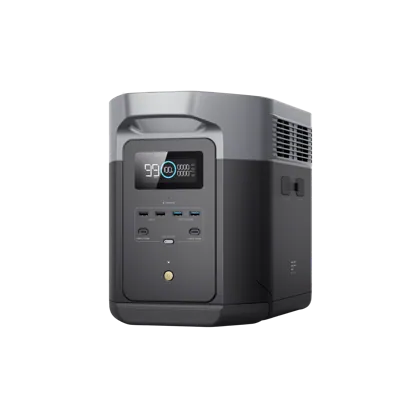
EcoFlow · Large
DELTA 2 Max
- 2,048Wh
- 2,400W out
- 50lb
Two kilowatt-hours with 2,400 W output and up to 1,000 W of solar input. Built for home backup and RVs rather than carrying around.
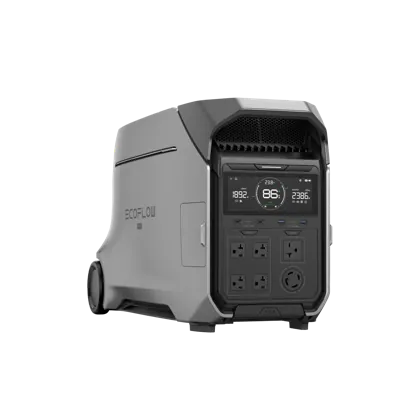
EcoFlow · Whole-home
DELTA Pro 3
- 4,096Wh
- 4,000W out
- 113.5lb
A 4 kWh, 4,000 W home-backup system with 120/240 V output and 2,600 W of solar input, expandable to about 12 kWh. Heavy at 113.5 lb.
As an Amazon Associate I earn from qualifying purchases.
For more options, see best power stations for home backup and our outage checklist.