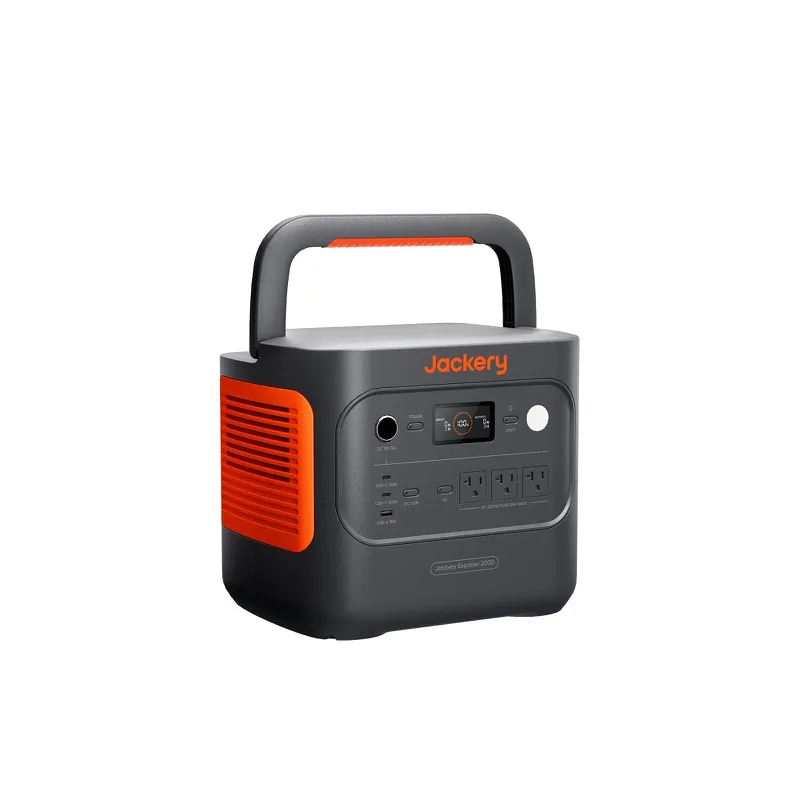
Image: Jackery
Jackery · Large power station
Jackery Explorer 2000 v2
2 kWh and 2,200 W in a 39.5 lb unit with fast wall charging. Only three AC outlets, modest solar input and no expansion.
- Capacity
- 2,042 Wh
- Output
- 2,200 W
- Weight
- 39.5 lb
- Solar in
- 400 W
We may earn a commission when you buy through links on this page. As an Amazon Associate I earn from qualifying purchases.
List price $999 at Jackery’s US store (checked Oct 13, 2026). Amazon’s price may differ.
Strengths
- Long-life battery rated for 4,000 cycles
Weaknesses
- Lower solar input than most rivals (400 W)
- Can’t add extra batteries
Strengths and weaknesses are calculated against current stations from half to double its capacity.
Our take
Great for
- A 2 kWh home backup you can still lift: 39.5 lb, among the lightest in its class
- Fast recovery: a full wall charge in about 1 hour 42 minutes
- Long life: rated for 4,000 cycles
Skip it if
- You need many outlets at once: it has three AC outlets
- You’ll charge mainly from solar: 400 W of input is low for 2 kWh
- You want to expand later: it’s a fixed-capacity unit
Bottom line: The Explorer 2000 v2 is the portable way to get 2 kWh: lighter than the DELTA 3 Max and Elite 200 V2, with a strong 2,200 W inverter and a 4,000-cycle battery. Its trade-offs are outlets and solar input. Compare it with the EcoFlow DELTA 3 Max.
Based on manufacturer specs, our runtime math and comparisons with similar stations. We don’t lab-test units.
Good fit for
What can the Explorer 2000 v2 run?
Estimated time running one device on its own, at 85% usable capacity and with 10% power headroom. To combine devices, use the runtime calculator.
“Borderline” means the station’s rating is within 10% of what the device needs, so it depends on your exact appliance.
Full specifications
| Battery capacity | 2,042 Wh |
|---|---|
| Continuous AC output | 2,200 W |
| Surge / peak output | 4,400 W |
| Battery chemistry | LiFePO4 |
| Rated charge cycles | 4,000 |
| Lifetime energy (capacity × cycles) | 8,168 kWh |
| Weight | 39.5 lb |
| Energy per pound | 51.7 Wh/lb |
| AC outlets | 3 |
| Max USB-C output | 100 W |
| Max solar input | 400 W |
| Wall charge to 100% | 102 min |
| Expandable to | Not expandable |
| List price | $999 at Jackery’s US store (checked Oct 13, 2026) |
| Manufacturer | Jackery product page |
Specs checked against the manufacturer on Oct 13, 2026. “—” means the maker doesn’t publish the figure. Brands measure cycle life to different end points (70% vs 80% remaining), so compare cycle counts loosely.
Head-to-head verdicts
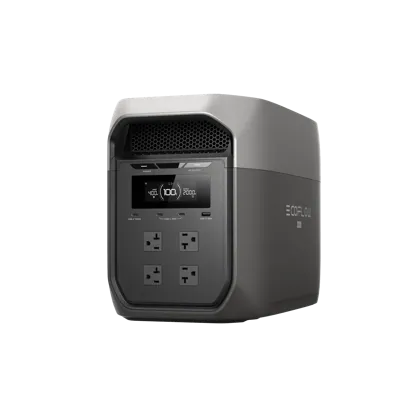
Compare with similar stations
Questions
How long will the Jackery Explorer 2000 v2 run a refrigerator?
About 33.1 h for a typical full-size fridge (150 W running, roughly 35% compressor duty cycle). Newer energy-efficient fridges will run longer.
Can the Jackery Explorer 2000 v2 run a microwave?
Yes. A 1,000 W microwave draws around 1,500 W from the outlet, within its 2,200 W continuous output. Ten minutes of use takes about 14% of the battery.
How long does the Jackery Explorer 2000 v2 take to charge?
About 102 minutes from a wall outlet (manufacturer figure). With solar at its 400 W maximum input, a full charge takes about 5.1 hours of full sun, or about 7.3 hours at typical real-world panel output.
What battery does the Jackery Explorer 2000 v2 use and how long will it last?
It uses LiFePO4 cells rated for 4,000 charge cycles, about 8,168 kWh of total delivered energy. LiFePO4 is the most durable common chemistry for power stations.
Related guides
 How long will a power station run a CPAP?How many nights each current power station runs a CPAP, with and without the humidifier, what size you need, travel rules and how to stretch your runtime.
 Best power station for Starlink: how long will it run?How much power Starlink uses, how long each current power station runs it, and how to power Starlink Mini and Standard off-grid, in an RV or in outages.
 How long will a portable power station run a refrigerator?Real fridge, mini fridge and freezer runtimes for every current power station, why start-up surge matters, food-safety timelines and how to stretch your battery.